
Innovative project was developed by Vinicius Wilbert, as part of his Design Course Conclusion Project at Feevale University
While watching an emergency response simulation conducted by the SAMU team when he was still a student in the Design course at Feevale University, Vinicius Wilbert was touched by the fact that every second can mean saving a life. This experience provoked deep empathy in the student, who began to research health and emergency services in depth, with the purpose of using design as a tool for social impact to expedite care.
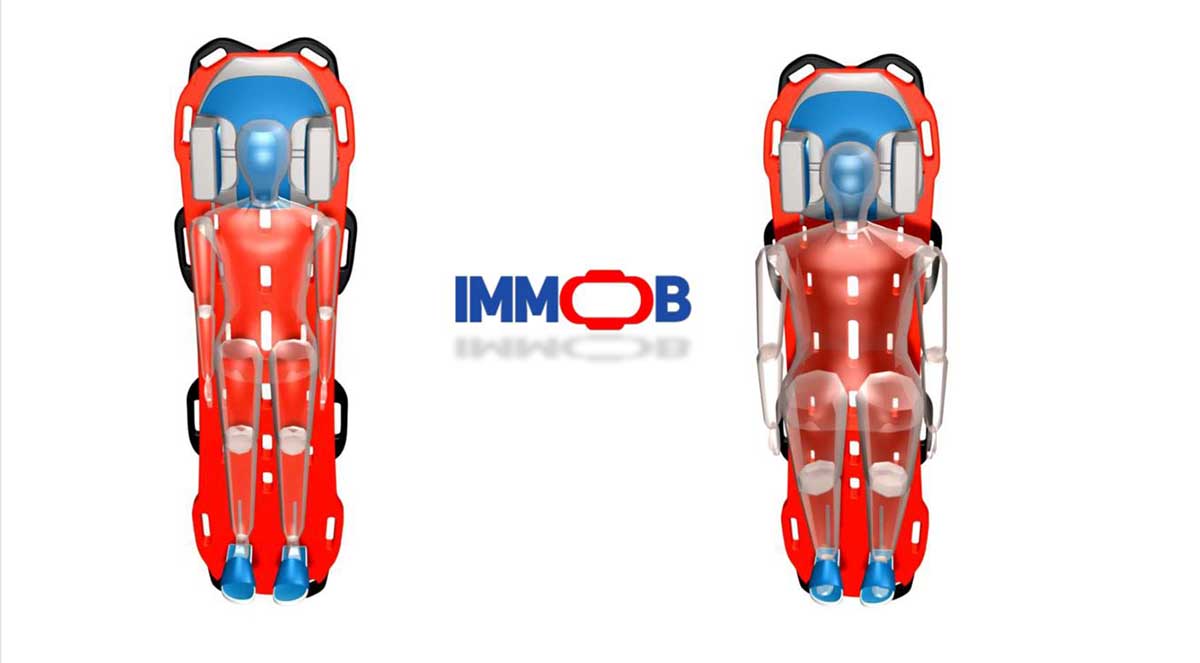
Thus, Wilbert developed the project "Stretched for First Aid and Emergency," under the guidance of Professor Jacinta Sidegum Renner. The result of the designer's Course Conclusion Project (TCC), the product had its patent granted this month by the National Institute of Industrial Property (INPI). The registration took place through the Innovation and Technology Transfer Center of Feevale. The invention was named IMMOB, a first aid stretcher with a retractable and adaptable system, capable of adjusting to each person's body type. Attached to it, Wilbert also designed head and foot immobilizers with movement functions, allowing them to adapt perfectly to any person, providing more comfort, safety, and efficiency during transport.
Designer closely followed the work of SAMU (Mobile Emergency Care Service)
For the development of the project, the designer followed the work of SAMU in Campo Bom, accompanying a team of 14 members, including drivers and nursing technicians. The objective was to understand the main difficulties faced by professionals during emergency care, especially those that impacted the speed and efficiency of the process. "I participated in patient care and conducted observations and questionnaires, and based on this, it became clear that the biggest challenge was in immobilization and transport, since the tools used were not always compatible with different biotypes and anthropometric characteristics, especially in cases of obese people and children," explains Wilbert. The designer says that, during the project completion process, conceptual models and three-dimensional representations were developed that allowed for the evaluation of the feasibility and ergonomics of the proposal. "In addition to the digital representations, I created exploratory physical prototypes to analyze dimensions, movement mechanisms, and the functioning of the stretchers’ retractable system and the attached immobilizers," points out Wilbert, who even took a stretcher from the SAMU (Mobile Emergency Care Service) to his home for studies. "I even tested myself on it to put myself in the patient's place," he recalls.
Next steps
Now, with the patent granted, Wilbert's focus is on creating functional prototypes with materials and components equivalent to those that would be used on an industrial scale, for technical validation and certification with competent bodies. In addition, the project is now entering a new stage of prospecting strategic partners, aiming at industrial development, homologation and future commercialization of the product. "The purpose is to bring design closer to the reality of professionals working in the field, contributing in a practical way to saving lives," he adds. To help him proceed with this stage, the designer will have the partnership of Feevale's Innovation Directorate, through the Innovation and Technology Transfer Center. More information about the invention and how to become a partner in the project can be obtained by email nitt@feevale.br or by WhatsApp (51) 99612-4002.

