
Material is an alternative to the use of hydrofluoric acid in the surface modification process associated with the manufacture of implants
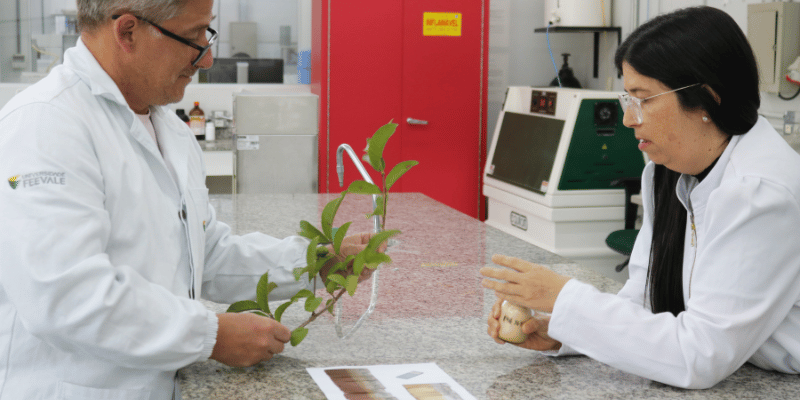
The National Institute of Industrial Property (INPI) has granted Feevale University a patent for the process of "Obtaining Psidium guajava extract and its use as an electrolyte," valid for 20 years. The project focused on the use of the extract from the leaves of Psidium guajava, the scientific name for guava, as a means of modifying metallic surfaces. According to Claudia Trindade Oliveira, professor of the Postgraduate Program in Materials Technology and Industrial Processes, the work
focused on replacing hydrofluoric acid, used industrially for the surface modification of metallic biomaterials, with the leaf extract. According to her, this surface modification process is essential for osseointegration to occur, ensuring the biocompatibility of the metal with bone tissue.
This surface modification of the metallic material, adds the professor, is done using hydrofluoric acid, which is a dangerous substance capable of causing severe and deep burns and systemic poisoning, representing a significant occupational risk for people involved in the surface modification process of implants. As an alternative, Feevale researchers developed an electrolyte based on guava leaves. The patent uses a methodology for easily obtaining the extract, followed by treatment that allows the material to be stored in powder form for later use, says Professor Fernando Morisso, co-author of the project.
From this, the researchers tested the use of Psidium guajava extract as an environmentally friendly electrolyte in the anodizing process, which promotes modification, through oxide formation, on the metallic surface of the implant. "We observed that there is reproducibility in the anodizing process. Tests were carried out with leaves stored for up to six months and tests with leaves from different regions. All of them reproduced the anodizing process on titanium implants," says Professor Claudia. She states that there is already a partner company interested in the project and that the idea is to transfer the technology, adapting the process for industry.
The Director of Innovation at Feevale University, Manuela Bruxel, emphasizes the importance of obtaining the patent, as the Institution stands out for the leading role of its professors and students in research and innovation. "This consolidates a strong ecosystem through granted patents, which ratify the quality of the products generated within the University and guarantee creative and impactful solutions for society and the market," adds the director.
The project is the responsibility of the professors from the Postgraduate Programs Claudia Trindade Oliveira, Fernando Dal Pont Morisso, Carlos Leonardo Pandolfo Carone (Materials and Industrial Processes), Juliane Deise Fleck (Virology) and Cristiane Bastos de Mattos (Toxicology and Toxicological Analysis), the lecturer Luciane Taís Fuhr (Mechanical Engineering course), the alumni Jussara Elisabeth Kuhn Mottin (Pharmacy) and Luã Tainachi Mueller (Mechanical Engineering) and the postdoctoral researcher from the PPG in Materials Technology and Industrial Processes, Sandra Raquel Kunst.

